Digital inclusion — “local and community-based”
Martha Lane Fox, the recently appointed Champion for Digital Inclusion visited Bristol recently. I was asked to come along and give a five-minute talk about the work that Bristol Wireless has been doing to promote ‘digital inclusion’. I have reproduced my notes for the talk below; although they weren’t delivered in full on the day, I think the spirit of the message was well received.
As it turned out we actually ended up having more of a round table discussion, rather than a series of presentations, which was far more productive. I was very impressed by the ideas that Martha was putting forward, including an emphasis on peer to peer learning, and how they meshed with the ideas coming from the public and third sector groups in the room. I certainly left at the end of the day feeling very optimistic about the fact that there was somebody inside government with a real understanding of the issues pushing realistic solutions.
Bristol Wireless Community Co-operative was founded in 2002 (and incorporated in 2003) with the specific aim of bridging the digital divide even then becoming apparent in the city.
Our mission is to provide computers, connectivity and the skills to use them to disadvantaged or excluded people at zero or very low cost.
We do this in three ways:
- by building and operating a city wide wireless network which connects public, private and third sector groups;
- by collecting old PCs, refurbishing them with open source software and redistributing them;
- and by offering training in the skills to use them effectively and become an engaged online citizen.
We have a strong focus on social inclusion and community development; we strive to work with the most disadvantaged people and communities.
There are believed to be as many as fifteen million people in the UK who are not online.
Of those without Internet access at home:
- 18% say they are are intending to get it
- 30% say they ‘can’t afford it’ or have ‘no computer’
- 42% say ‘there’s no need’ or ‘I’m not bothered’
As the Digital Britain report recognises:
It is already increasingly the case that those without access to the Internet suffer economic disadvantage. Their opportunities and livelihoods can be compromised by exclusion from the digital world.
More fundamentally, they miss out on areas of learning … easy access to relevant information, … and creative development which is
increasingly part of the “social glue” for friends, families, communities of interest and society as a whole.
The danger with centralised, top down approaches to promoting digital inclusion is that they are seen as impersonal, inflexible and irrelevant. They also risk being co-opted by large profit-driven corporations, which can engender or reinforce cynicism.
Grass roots initiatives which are rooted in local communities offer a more authentic approach to inclusion.
People learn from their friends and neighbours and come to understand how they themselves could benefit.
They have more of a sense of ownership and participation.
Over the last seven years we have distributed hundreds of refurbished PCs to everybody from the children at a local primary school to the residents of sheltered housing. We have given people access to computers, connectivity and the skills to use them.
And the way we have done it has had a real effect on social cohesion.
Supporting social enterprises like Bristol Wireless through partnerships at national and local level will be the most effective way to reach out to the digitally excluded and to motivate and enable them to get connected and engaged online.
Digital converts often become enthusiasts, even evangelists, their genuine enthusiasm proves infectious to friends and family.
The more involved and connected people become, the more they strengthen social ties within and between communities.
We aren’t in this to make money, we do it because we believe in it.
Connectivity is the lifeblood of co-operation. We have seen that this stuff can bring people together, improve communication and make it easier to work with one another and share what we care about – whether that’s politics, music, football, climate change or anything else.
The Digital Britain report describes the National Plan for Digital Participation, which combines:
an improved offer to increase motivation to get online, with social networking and outreach, and with skills training.
and, crucially, the report goes on to say:
The National Plan will be delivered through tailored local and community-based programmes which build on existing networks.
My plea to you today is to make good on that promise — to make sure that wherever possible the National Plan (and the Home Access scheme) works to strengthen and consolidate existing grass roots efforts.
It is vital that the knowledge, experience and goodwill which has built up over the years in many such organisations is not dissipated but focused and applied to the goals we all share.
Thank you.

 Your correspondent (for his sins. Ed.😀 ), in addition to filling the role of press officer for Bristol Wireless, also acts as the co-operative’s Company Secretary. As a part of that that role the following email has today been circulated on Bristol Wireless’ general mailing list:
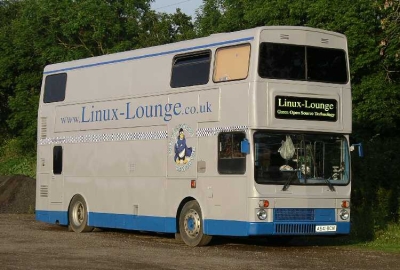 Our old friend John Palfrey has emailed us with an update and picture of his Linux Lounge bus, which is gradually coming together as a showcase for open source IT and green energy technologies.
 Are you doing or have just done your A Levels and want to do practical technical computing? As we previously reported (
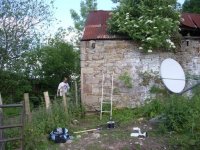 About a week ago I wrote a piece (
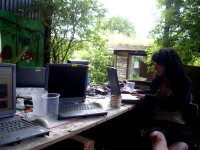
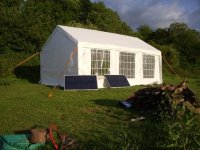 Hacktionlabbers started turning up from the afternoon onwards, the most thought-provoking being the arrival in the early evening of Alan who’d cycled all the way from Sheffield (150 miles away) in 11 hours. The most welcome vehicular appearance on site was Llanos, whose wee blue hatchback made it to within some 100 metres from the barn despite being fully laden with essential supplies – cider and a barrel of beer. 😉 Another welcome arrival was fellow BW volunteer Hamish, fresh from Scotland with a goodie bag of traditional Scottish fare – shortbread, potato scones, oatcakes and
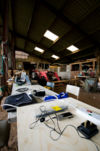
  Hacktionlab also gave a showcase for low power and renewable technologies: there was our
  I had an email from fellow Bristol Wireless volunteer Mike last night asking if I could fiddle with the order of posts on the site to bring the last post on Hacktionlab (
 Yesterday Jules, our Bristol Wireless treasurer, took delivery of a brand new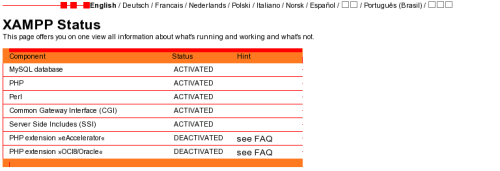
 vnunet.com reports that almost 2 years after the WEEE disposal rules came into force, the UK is still lagging behind the rest of Western Europe in recycling electrical goods.
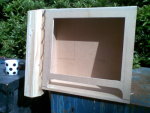 Regular readers of Bristol Wireless News may recall that in early 2008 we had a series of secure cabinets designed and built for the public access internet suite at
  The aim of HacktionLab is to bring together people interested in and/or working in the areas of alternative media, renewable energy, on-line video distribution, free software and any other form of activism that uses technology.
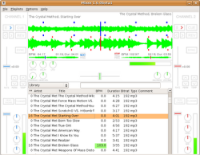 If any one is interested in trying out a bit of digital Djing I would highly recommend